Hey Mr Lau,
Thanks for your comments. :)
I got the idea from this source that i posted earlier:
http://www.tribology-abc.com/abc/friction.htm
| How to measure friction? |
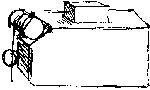 | Method 1 Weight ratio The sketch shown originates from Leonardo da Vinci (ca 1500). He studied friction by measuring the load hanging on a cord, at which the block begins to slide. The coefficient of friction is found by the quotient of the dead weight of the mass hanging on the cord and the mass of the block, i.e.
µ = Ff / N = mdead weight / mblock
|
Static coefficient of friction - dynamic coefficient of friction The moment at which the block begins to slide (break away force) is the so called static friction, the force at which the block continues to slide is the dynamic or kinetic coefficient of friction. For most material combinations the value of the static friction exceeds that of the dynamic friction. Be aware that the dynamic friction can still be dependent on velocity, contact pressure, temperature and surface roughness. The static friction can be dependent on the time that the block is in rest, which is typically the case when lubricated.
I think we would be measuring static friction since once the load overcomes the opposing force, i presume the object would keep moving till it falls of the surface or the load hits the ground. Is that right?
Oh, and can i ask this question? Why won't it score well?
Is it better if i use only one fixed surface but change the mass if the object . In this case, our project would simulate the sport of Grand Prix where the fixed surface represents the racing track and the objects with different mass represents the different racing cars.
Independent Variable: The object
Dependent Variable: The static friction
Can? :) |
|

Good! You are correct that you are measuring static friction with this setup. Do note that you are not interested in the coefficient of friction in this project - just the static friction itself. once the weights exceed the static friction, the object will probably accelerate and crash.
ReplyDeleteAs for why this will not score, your independent variable currently has no values. Read my blog for details.
About your idea on F1, I'm quite interested! What EXACTLY are you proposing as your IV (besides "the object")?