Thursday, 7 July 2011

Revised Proposal

Lower Secondary Science Research Project
Proposal Form


Group Name: ________________________________                Class: __2D_______

Name of Members and Signatures:  1)         Dylan Huan (Track)                             
2)         Dylan Tan (Swimming)             
                                                                        3)         Hakim (Track)                                     
4)         Audrey (Sailing)                                   
                                                                        5)                                                                    
Project Title:

Factors Affecting Friction                                                                                     

Problem Question:

To investigate how the weight of an object affects the amount of static friction between the object and the surface.  Hypothesis:


The larger the weight of the object, the bigger the amount of static friction between
the object and the surface. 

Web-Address (Url) of Project Blog:

factorsaffectingfriction.blogspot.com                                                                    


Expected date of research completion:                                                              


Project Mentor and Signature:                                                                          


Apparatus and Materials Needed:

1.     Tile
2.     Electronic balance
3.     Beaker
4.     Water/Sand
5.     Screw hook
6.     Pulley system

Experimental Procedure Setup:

Step 1: Prepare a tile to use as the fixed surface
Step 2: Prepare 4 objects of the same material but of different weights
Step 3: Attach a hook to each object so that the pulley system can be hooked onto       the object
Step 4: Weigh each object and record it down
Step 5: Place the object onto the tile and hook the pulley system to the object.
Step 6: Start adding weight to the load until the object moves
Step 7: Quickly catch hold of the load and take it out to measure how much it weighs.
Step 8: Record the weight of the load.
Step 9: Repeat step 4 to 9 for the rest of the objects


Independent Variable:                Weight of the object                                              

Dependent Variable:                  Amount of static friction between the object and the

surface     

Controlled Variables (Constants):

Surface used throughout the experiment (tile), material of object, hook, pulley system.


Friday, 24 June 2011

Mr Lau;

The mass of the object will change the amount of friction. If the object is heavier, greater pressure is acting on it, increasing the friction. But i think a better IV and DV would be the mass of the object and the load added to overcome the friction respectively.

Wednesday, 22 June 2011

Mr Lau;

Hmmm, i guess the IV would be the mass of the object.

Monday, 20 June 2011

Mr Lau;

Hey Mr Lau,
Thanks for your comments. :)
I got the idea from this source that i posted earlier: http://www.tribology-abc.com/abc/friction.htm

 How to measure friction?
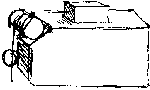
Leonardo da Vinci (ca 1500) Method 1 Weight ratio The sketch shown originates from Leonardo da Vinci (ca 1500). He studied friction by measuring the load hanging on a cord, at which the block begins to slide. The coefficient of friction is found by the quotient of the dead weight of the mass hanging on the cord and the mass of the block, i.e.
 ยต =  Ff / N = mdead weight / mblock
 
Static coefficient of friction - dynamic coefficient of friction The moment at which the block begins to slide (break away force) is the so called static friction, the force at which the block continues to slide is the dynamic or kinetic coefficient of friction. For most material combinations the value of the static friction exceeds that of the dynamic friction. Be aware that the dynamic friction can still be dependent on velocity, contact pressure, temperature and surface roughness. The static friction can be dependent on the time that the block is in rest, which is typically the case when lubricated.

I think we would be measuring static friction since once the load overcomes the opposing force, i presume the object would keep moving till it falls of the surface or the load hits the ground. Is that right?
Oh, and can i ask this question? Why won't it score well?


Is it better if i use only one fixed surface but change the mass if the object . In this case, our project would simulate the sport of Grand Prix where the fixed surface represents the racing track and the objects with different mass represents the different racing cars.
Independent Variable: The object
Dependent Variable: The static friction
Can? :)

Sunday, 19 June 2011

Drawings

Ok, here's the drawings. :)


Is it ok? :)

Well, i figured you can't really see what the scanned in picture wrote so i shall type it out instead. Sorry.
So, assuming that the object weighs 100g and surface 1, 2 and 3 are the least rough, rough and roughest surface respectively, then the experiment would look like the drawings above. As you can see, as the surface gets rougher, it takes a heavier weight to make the object move. So, if we record these information down on a table it would look like the one above.
Ratio=F/m

Mr Lau, is this better?

Friday, 17 June 2011

YOU HAVE TO CHECK THIS OUT.

Hey guys. :) Ok, so here's a summary of  a new idea i have for the project. :)

Firstly, the object will be kept constant while the surfaces used will vary through out the experiment. Secondly, to measure friction, we could use a pulley system and attach it to the object. We would have to keep adding weights to the pulley system till the object moves.

So, this should be our procedure:
Step 1. Chose 3 different surfaces (eg: parquet, concrete and terracotta tiles)
Step 2: Chose a flat object preferably less than a kg.
Step 3: Attach a pulley system to the object and make sure weights can be added onto it.
Step 4: Place the object onto the first surface (eg: parquet) and start adding weights until the object moves.
Step 5: Record the weights added.
Step 6: Repeat step 4 and 5 for the other 2 different surfaces.
Step 7: Plot a graph and table. :)

*The frictional force needed to overcome the mass of the object would be measured using the ratio of the weight added and the mass of the object. ---> Ratio: weight added/mass of object

So... For example, the object weighs 100g and for the test on parquet floor requires a 5g weight to be added, then the frictional force is 0.05N.

How does it sound? :)

Thursday, 16 June 2011

How to post a comment

Haha, yes i don't know how to post a comment. I wrote a comment but can't post it even though i used a google account.

 Anyway, what i wanted to say is my science notebook is with you guys. :) its in the plastic bag with the blocks that i gave to hakim before i left. :) Please tell me its still with you. :)