Friday, 24 June 2011
Mr Lau;
The mass of the object will change the amount of friction. If the object is heavier, greater pressure is acting on it, increasing the friction. But i think a better IV and DV would be the mass of the object and the load added to overcome the friction respectively.

Wednesday, 22 June 2011
Monday, 20 June 2011
Mr Lau;
Hey Mr Lau,
Thanks for your comments. :)
I got the idea from this source that i posted earlier: http://www.tribology-abc.com/abc/friction.htm
Thanks for your comments. :)
I got the idea from this source that i posted earlier: http://www.tribology-abc.com/abc/friction.htm
| How to measure friction? | ||||
| ||||
Sunday, 19 June 2011
Drawings
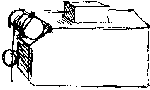
Ok, here's the drawings. :)
Well, i figured you can't really see what the scanned in picture wrote so i shall type it out instead. Sorry.
So, assuming that the object weighs 100g and surface 1, 2 and 3 are the least rough, rough and roughest surface respectively, then the experiment would look like the drawings above. As you can see, as the surface gets rougher, it takes a heavier weight to make the object move. So, if we record these information down on a table it would look like the one above.
Ratio=F/m
Mr Lau, is this better?
 |
| Is it ok? :) |
Well, i figured you can't really see what the scanned in picture wrote so i shall type it out instead. Sorry.
So, assuming that the object weighs 100g and surface 1, 2 and 3 are the least rough, rough and roughest surface respectively, then the experiment would look like the drawings above. As you can see, as the surface gets rougher, it takes a heavier weight to make the object move. So, if we record these information down on a table it would look like the one above.
Ratio=F/m
Mr Lau, is this better?
Friday, 17 June 2011
YOU HAVE TO CHECK THIS OUT.
Hey guys. :) Ok, so here's a summary of a new idea i have for the project. :)
Firstly, the object will be kept constant while the surfaces used will vary through out the experiment. Secondly, to measure friction, we could use a pulley system and attach it to the object. We would have to keep adding weights to the pulley system till the object moves.
So, this should be our procedure:
Step 1. Chose 3 different surfaces (eg: parquet, concrete and terracotta tiles)
Step 2: Chose a flat object preferably less than a kg.
Step 3: Attach a pulley system to the object and make sure weights can be added onto it.
Step 4: Place the object onto the first surface (eg: parquet) and start adding weights until the object moves.
Step 5: Record the weights added.
Step 6: Repeat step 4 and 5 for the other 2 different surfaces.
Step 7: Plot a graph and table. :)
*The frictional force needed to overcome the mass of the object would be measured using the ratio of the weight added and the mass of the object. ---> Ratio: weight added/mass of object
So... For example, the object weighs 100g and for the test on parquet floor requires a 5g weight to be added, then the frictional force is 0.05N.
How does it sound? :)
Firstly, the object will be kept constant while the surfaces used will vary through out the experiment. Secondly, to measure friction, we could use a pulley system and attach it to the object. We would have to keep adding weights to the pulley system till the object moves.
So, this should be our procedure:
Step 1. Chose 3 different surfaces (eg: parquet, concrete and terracotta tiles)
Step 2: Chose a flat object preferably less than a kg.
Step 3: Attach a pulley system to the object and make sure weights can be added onto it.
Step 4: Place the object onto the first surface (eg: parquet) and start adding weights until the object moves.
Step 5: Record the weights added.
Step 6: Repeat step 4 and 5 for the other 2 different surfaces.
Step 7: Plot a graph and table. :)
*The frictional force needed to overcome the mass of the object would be measured using the ratio of the weight added and the mass of the object. ---> Ratio: weight added/mass of object
So... For example, the object weighs 100g and for the test on parquet floor requires a 5g weight to be added, then the frictional force is 0.05N.
How does it sound? :)
Thursday, 16 June 2011
How to post a comment
Haha, yes i don't know how to post a comment. I wrote a comment but can't post it even though i used a google account.
Anyway, what i wanted to say is my science notebook is with you guys. :) its in the plastic bag with the blocks that i gave to hakim before i left. :) Please tell me its still with you. :)
Anyway, what i wanted to say is my science notebook is with you guys. :) its in the plastic bag with the blocks that i gave to hakim before i left. :) Please tell me its still with you. :)
Monday, 13 June 2011
Mr Lau,
Um, because i thought that measuring friction would be tedious so i was looking for an alternative method to prove our hypothesis right. Also, i was unsure how to measure friction but i am still researching on it. Thank you for your comments. :)
Sunday, 12 June 2011
Mr Lau,
Hey Mr Lau, do we have to measure the frictional force? Or can we change our hypothesis to: As the mass of the wooden block increases, it taked a longer time to travel the same distance. Therefore, it travels with a slower speed, which also means there is greater friction.
Saturday, 11 June 2011
Re: Friction
The type of friction that is related to our experiment would be sliding friction (i.e: the force resulting when pushing or pulling an object over a surface). In this case, pulling the different weighted wooden blocks across the netball court would result in sliding friction. The link below tells us how to measure static sliding coefficient of friction with a ramp. It is a little complicated, though.
http://www.school-for-champions.com/science/experiments/expfriction_static_coeff_ramp.htm
http://www.school-for-champions.com/science/experiments/expfriction_static_coeff_ramp.htm
Tuesday, 7 June 2011
Friction
These are the 4 types of friction:
1. Static
2. Sliding
3. Rolling
4. Fluid
Static
A smooth surface does demonstrate as much friction as a rough surface.
A lubricant can be used to reduce friction.
1. Static
2. Sliding
3. Rolling
4. Fluid
Static
- It is friction that acts on something that is not moving
- Eg: A piano is held in place by static friction
- Static friction keeps you in your seat
- No heat or wear is generated
- It is a force resulting when pushing or pulling an object over a surface
- Eg: Pushing a box across the floor
- Heat and wear can result
- Contact is reduced because of rollers or wheels or ball bearings
- Eg: Skate boards have ball bearings in the wheels
- Eg: A cart has wheels
- Less heat and wear will result in comparison with sliding.
- Resistance from a liquid or air
- Eg: Stirring a thick batter
- Eg: Walking through water
- Eg: Olympic bike riders
A smooth surface does demonstrate as much friction as a rough surface.
A lubricant can be used to reduce friction.
Saturday, 4 June 2011
What is friction ? And how to measure it.
Friction is like the "evil" of all motions. No matter which direction something moves in, friction pulls it the other way. Move something left, friction pulls right. It is a force that appears whenever two things rub against each other.
How to measure friction ? Frictional force (Ff) is equal to the coefficient of friction (µ) multiplied by the normal force (Fn).
Definition of coefficient of friction --> The coefficient of friction is a number which represents the friction between two surfaces. Between two equal surfaces, the coefficient of friction will be the same. The symbol usually used for the coefficient of friction is (µ)
Definition of normal force -->
The force exerted by a surface on an object in contact with it which prevents the object from passing through the surface; the force is perpendicular to the surface, and is the only force that the surface exerts on the object in the absence of frictional forces.
However, i do not know how to measure this two things, any suggestions ?
How to measure friction ? Frictional force (Ff) is equal to the coefficient of friction (µ) multiplied by the normal force (Fn).
Definition of coefficient of friction --> The coefficient of friction is a number which represents the friction between two surfaces. Between two equal surfaces, the coefficient of friction will be the same. The symbol usually used for the coefficient of friction is (µ)
Definition of normal force -->
The force exerted by a surface on an object in contact with it which prevents the object from passing through the surface; the force is perpendicular to the surface, and is the only force that the surface exerts on the object in the absence of frictional forces.
However, i do not know how to measure this two things, any suggestions ?
Subscribe to:
Posts (Atom)